Anthropic's trust: 1,000 shares, five seats, three documents
On August 4, 2026, Anthropic created the post of Chief Global Affairs Officer and gave it to Mariano-Florentino Cuéllar, a former justice of the California Supreme Court. The fourth paragraph of the announcement has three sentences:
Tino has served as a Trustee of Anthropic’s Long-Term Benefit Trust since January 2026. He has stepped down from the Trust to join the company. The Trust will select a successor under its normal process.
He went from the body that oversees the company straight into its management, six and a half months after joining the trust.
The January announcement that named him a trustee quoted him saying this:
As AI capabilities advance at an unprecedented pace, the need for governance structures that marry private sector dynamism with civic responsibility has never been more urgent. … The Long-Term Benefit Trust represents a thoughtful approach to ensuring that as these powerful systems evolve, decisions about their development remain grounded in the broader public interest. I’m honored to contribute my experience to this important work.
That announcement also noted that he had already said he would leave the Carnegie Endowment for International Peace in July and return to Stanford to lead the Center for Advanced Study in the Behavioral Sciences and the Knight-Hennessy Scholars program. By that plan, he was due back at Stanford in July. In August he went to Anthropic.
For this move, Anthropic’s entire explanation is the three sentences at the top, and not one word of it mentions a conflict of interest. As I write, no successor to his trustee seat has been announced.
Changing jobs is Cuéllar’s right. Trustees serve one-year terms, and American governance has precedents for one going to work for the party being overseen.
What I wanted to know was something else: what power this trust holds, and who can take it away. The answer is in Anthropic’s certificate of incorporation, the founding document the company files with the State of Delaware. How many classes of stock there are, what rights each class carries, how directors are elected, whose approval it takes to change any provision: the certificate governs all of it, and the bylaws can’t contradict it.
It isn’t free to read. You order it from the Delaware Secretary of State: $10 for the first page and $2 for each page after that, about $60 for the 26-page copy. The state’s free search gives only the company name, file number, incorporation date, and registered agent, with no filing history. To see the current governing documents of a company preparing to go public at a $2 trillion valuation, you have to pay, and guess which filings to buy, one at a time.
First, what those 26 pages say.
This is an analysis of public documents. I did not contact Anthropic to check facts or ask for comment, so every judgment about intent here is one reader’s inference. Which versions of the documents I used, how I checked them, and what I couldn’t verify are set out at the end.
Two years ago, someone read this far and wrote “seems crazy”
On June 12, 2024, Zach Stein-Perlman published a reading of Anthropic’s certificate of incorporation on AI Lab Watch. He is the most diligent independent observer in this field. In a footnote to that post, he wrote:
I think there’s a tension between Article IV(D)(5)(a) and Article IX. I suspect I misunderstand Article IV(D)(5)(a) in the context of the whole document; I will ignore it here for now.
My reading, which seems crazy: per Article IV(D)(4)(b), the Class T stock will exist perpetually unless its holder—the Trust—decides to convert it. Per Article IV(D)(5)(a), as long as the Class T stock exists, Anthropic can’t disempower its holder.
He spelled out the reading, said himself that it “seems crazy”, and set it aside on the spot. (The Article IX he wrote is a typo. He writes IX in both the footnote and the body; the corresponding provision in the certificate is Article XI.)
In the same post he also stated the other half of the argument. He copied out the full text of the Transfer Approval Threshold, the supermajority stockholders would need to get around the trust. Then he wrote:
If Anthropic’s description above is about this, it’s odd and misleading. Perhaps Anthropic’s description is about the Trust Agreement, not just the CoI.
He didn’t take it further. His comment under his own post on June 13, 2024 is the last thing he said about this clause:
I’m still confused about Article IV(D)(5)(a) (p. 18) of the CoI. See footnote 3.
In November 2025, in a different discussion, he wrote:
afaik the only lawyers who’ve read the Anthropic CoI are Anthropic lawyers and advisors, so it might be cool if one independent lawyer read it from a skeptical/robustness perspective
I had spotted the link between those two articles on my own, and only found this footnote a day later. To be honest it was a little deflating, and then I felt something else: someone who knows more than I do, and works harder than I do, stood in the same spot two years ago, wrote “seems crazy”, and walked away. The lead has hung there for two years.
So what this piece adds is not a “discovery”. It takes a shelved intuition all the way through, filling in the provisions’ own wording, the workarounds that are sealed off, and why that “Perhaps” should be “necessarily”. I am not a lawyer. What follows is a reading worked out from the text, and anyone who knows the field is welcome to take it apart.
All of the trust’s power hangs on 1,000 shares
The company was incorporated in Delaware in January 2021. Article III of the certificate states its specific public benefit in one sentence of 24 words:
The specific public benefit that the Corporation will promote is to responsibly develop and maintain advanced AI for the long term benefit of humanity.
In the filed original, “long term” has no hyphen. Anthropic’s website, law firm briefings, and nearly every secondhand quotation write “long-term”. Most people who quote this sentence have not seen the filing.
The public benefit corporation (PBC) form requires the board to balance stockholders’ financial interests against the public benefit, but almost no one can enforce that: directors owe no duty to the public, and only stockholders holding at least 2% together can sue. Anthropic’s own website says “makes it legally permissible”, which is the language of permission, not obligation.
The part that does the work is Article IV(D). The company is authorized to issue 1,740,472,959 shares, of which 1,000 are Class T Common Stock, less than one in a million of the authorized shares. These 1,000 shares have none of the three usual rights of common stock: no dividends, nothing on liquidation, no vote on general matters. Their only power is to elect and remove a portion of the directors, phased in by time and by fundraising milestones.
This isn’t dual-class stock. It is closer to a golden share. The advantage is that new issuances can’t dilute it, and directors are elected class by class.
Its protective clause is Article IV(D)5, under the heading Protective Provisions. Paragraph (a) opens like this:
At any time when any shares of Class T Common Stock are outstanding, the Corporation shall not, either directly or indirectly by amendment, merger, consolidation, conversion, recapitalization, reclassification, or otherwise, in one or more transactions or a series of related transactions, do any of the following without (in addition to any other vote required by law or this Restated Certificate) the written consent or affirmative vote of the holders of all of the then-outstanding shares of Class T Common Stock … and any such act or transaction entered into without such consent or vote shall be null and void ab initio, and of no force or effect
Then (i)(1) names what it protects:
amend, alter or repeal, or adopt any provision of this Restated Certificate that is inconsistent with, this Article IV(D), Article VIII(B)6(i)-(ii) or Article VIII(B)6(iv)-(vii) (including, without limitation, either such Article as renumbered as a result of any amendment, alteration, repeal or adoption of any other provision)
What it names is the whole of Article IV(D), not some subsection. The parenthetical “as renumbered” also closes off renumbering as a workaround.
Clause (i) has a second limb, a catch-all:
or (2) amend, alter or repeal any provision of this Restated Certificate or the Bylaws of the Corporation in a manner that adversely affects the powers, preferences or special rights of the holders of the Class T Common Stock
This limb reaches past Article IV(D). Any provision of the certificate or the bylaws, amended in a way that adversely affects Class T’s rights, needs the trust’s consent. The paragraphs of Article VIII(B) that set how many seats each class elects are not on the (1) list; an attempt to cut Class T’s seats runs into this limb.
The same clause leaves another opening. Article IV(D)5(a)(iii) says that increasing or decreasing the number of directors requires the trustees’ consent, unless at least half of the new seats are elected by Class T:
increase or decrease the authorized number of directors constituting the Board of Directors except for any increase in which at least half or more of such newly created directorships are elected by the holders of record of the Class T Common Stock, exclusively and as a separate class
Article VIII(B)4 of the certificate says that after the Final Phase-In Date (the last step in phasing in the trust’s powers, which fell in November 2024) the board is fixed at five seats, with Class T electing three. Three out of five, 60%.
Today six directors are serving, three of them chosen by the trust. 50%.
From five seats to seven, and now six directors in office: no step violates the text.
The last clause I only noticed on a reread. It is in Article VIII(B)6(i), and it defines what a “Class T Director” is:
“Class T Director” means any director elected by the holders of record of the Class T Common Stock, exclusively and as a separate class; provided, however, that “Class T Director” shall mean any director elected by the holders of record of the Voting Common Stock if at any time, and for so long as, there are no shares of Class T Common Stock outstanding
Once Class T shares no longer exist, the term “Class T Director” automatically switches to meaning “any director elected by the holders of record of the Voting Common Stock”.
The seats don’t sit empty waiting to be filled. They go straight back to the stockholders.
To take this lock apart, you don’t need to touch a single word about the mission. You only need to make those 1,000 shares disappear.
Making them disappear isn’t easy. Converting them to common stock takes three separate consents: a majority of Class T holders designating a conversion event, at least 75% of the authorized director seats, and stockholders reaching the Transfer Approval Threshold. None of the three gates is low.
The threshold Anthropic never published is in the certificate: 85%
In press coverage and in Anthropic’s own description, the structure has a failsafe: a large enough supermajority of stockholders can amend, or even strip, the trust’s powers without the trustees’ consent. Anthropic’s website says so, and the Financial Times calls it a kill switch outright.
Anthropic has never published the actual threshold. It is in Article IV(D)4(c)(iv), defined as the Transfer Approval Threshold, and it has two tiers. From November 2025 on, the second tier applies. (The switch comes on the first anniversary of the Final Phase-In Date, which is the earlier of May 24, 2027 and eight months after the company has raised $6 billion; Stein-Perlman noted in June 2024 that it fell in November 2024.)
either (x)(i) at least seventy-five percent (75%) of the Voting Common Stock then outstanding and held by the Founders …, (ii) at least fifty percent (50%) of the Series A Preferred Stock then-outstanding and (iii) at least seventy-five percent (75%) of the voting power of the outstanding Preferred Stock entitled to vote generally …, or (y) at least eighty-five (85%) of the voting power of the then-outstanding shares of the Corporation’s capital stock entitled to vote generally
The 85% in that tier is missing a “percent”. Every 75% before it is written “seventy-five percent (75%)”. Here it reads “at least eighty-five (85%)”.
The filing is a scan with no text layer. I read it by rendering the pages as images and running OCR. The first time I reached this spot I assumed the OCR had misread it, so I rendered that page at 300dpi and checked again. The word was still missing. The May 2024 version of the same paragraph also has “at least at least fifty percent (50%)”, with “at least” repeated. The March 2025 version fixed that one and left the missing “percent” alone.
A court would treat these as obvious scrivener’s errors, and the clause would not be invalid because of them.
The denominator has been shrunk. Both tiers explicitly exclude non-voting preferred stock. Brian Israel, then Anthropic’s general counsel, told TIME in 2024 what that means: Google and Amazon hold non-voting shares, so they can’t elect directors, and they don’t count in the denominator of this supermajority.
85% isn’t the only path either. The (x) path needs 75% of the Voting Common Stock held by the founders, 50% of the Series A, and 75% of the other voting preferred stock, each class approving separately. When the FT wrote about the kill switch, it mentioned only 85%. The Harvard Law School paper devoted to this switch gives no number at all: it says Anthropic doesn’t reveal the supermajority needed, and its footnote cites the drafting lawyers’ article, not the certificate. But the text is either-or, and (x) is usually much easier than assembling 85% of all voting power.
One leg of this path is 75% of the Voting Common Stock held by the founders.
And now The Information has reported, on August 18, 2026, that Anthropic plans to give CEO Dario Amodei and other co-founders a class of stock with extra voting power before the IPO (Reuters and Bloomberg picked up the report the same day; the exact vote ratio has never been disclosed; Anthropic did not respond to Reuters’ request for comment). The same report says the company also plans to keep the existing trust, which will go on electing a majority of the board through its special class of stock. The 85% threshold counts voting power, not economic interest. Once the founders have super-voting shares, the economic stake needed to put together 85% of the voting power gets smaller.
The switch around the trustees is in an unpublished agreement
In the certificate, the failsafe corresponds to Article XI. It provides that amending or repealing Article IV(D)4, or Article XI itself, requires a stockholder vote at the Transfer Approval Threshold and a vote of 75% of the Whole Board. Whole Board means the full number of authorized seats, vacancies included.
Its wording goes like this:
…notwithstanding any other provision of this Restated Certificate or any provision of law that might otherwise permit a lesser vote or no vote, but in addition to any vote of the holders of any class or series of the stock of this corporation required by law or by this Restated Certificate, the affirmative vote of stockholders of the Corporation representing at least the Transfer Approval Threshold shall be required to amend or repeal Article IV(D)4 or this Article XI…
“in addition to”. On top of any other vote.
And among those other votes is the consent of the holders of all Class T shares required by Article IV(D)5(a). The Transfer Approval Threshold is defined in Article IV(D)4, and (D)4 sits inside (D), which is exactly the scope that 5(a)(i)(1) names for protection.
So within the four corners of the certificate, changing that threshold takes three things at once: stockholders reaching the threshold, 75% of the Whole Board, and the consent of the Trust as holder of all the Class T shares.
in addition to is standard boilerplate in Delaware charters. It appears three times in this one document, in Article IV(D)5(a), Article IV(D)6, and Article XI, a stock phrase of the same drafter. A practicing lawyer would instantly see through an argument that rests its weight on boilerplate. So these three words only count as corroboration. The textual basis is that 5(a)(i)(1) names the whole of Article IV(D).
At this point, the conclusion I wrote down was: the failsafe that works “without the consent of the Trustees” has no footing in the public documents.
I left that sentence in the draft for a day.
Article IV(D)5(a) governs amendments to this certificate and to the bylaws. It says not a word about the trust agreement. And where it defines Transfer, Article IV(D)4(c)(iii) includes this sentence:
notwithstanding the foregoing, the following will not be considered a “Transfer”: (A) the entry into the Voting Agreement and the performance of any obligations or the taking of any actions thereunder, and (B) the performance of any obligations or the taking of any actions under that certain Trust Agreement of the Anthropic Long-Term Benefit Trust, as such trust agreement may be amended from time to time
The certificate itself carves actions under the trust agreement out of the transfer restrictions, and adds that the agreement “may be amended from time to time”.
So that sentence was wrong. The switch doesn’t need to be in the certificate. It sits at the level of the trust agreement, and the certificate itself points the way.
Not one word of the trust agreement has been made public, from 2023 to today.
This isn’t only my inference; the lawyers who designed and drafted the structure wrote about it themselves. In a piece on the Harvard Law School Forum on Corporate Governance, John Morley (Yale Law School), David Berger, and Amy Simmerman (Wilson Sonsini) explain that the three documents (the trust agreement, the certificate of incorporation, and the key agreement between the trust and the company)
all use a single, harmonized set of processes to permit amendments that could materially alter the Trust or its rights. These processes permit amendment by consent of the Voting Trustees and the company’s stockholders; by consent of the Voting Trustees and the company’s directors prior to the time the Voting Trustees gain the power to elect a majority of the directors; or by a supermajority of stockholders. Because the last possibility—amendment by a supermajority of stockholders—can be accomplished without the consent of the Voting Trustees, it operates as a kind of failsafe against the actions of the Voting Trustees and safeguards the interests of stockholders.
The three documents share one amendment process, and the supermajority route needs no trustee consent; the drafters call it a failsafe. I can read one of the three.
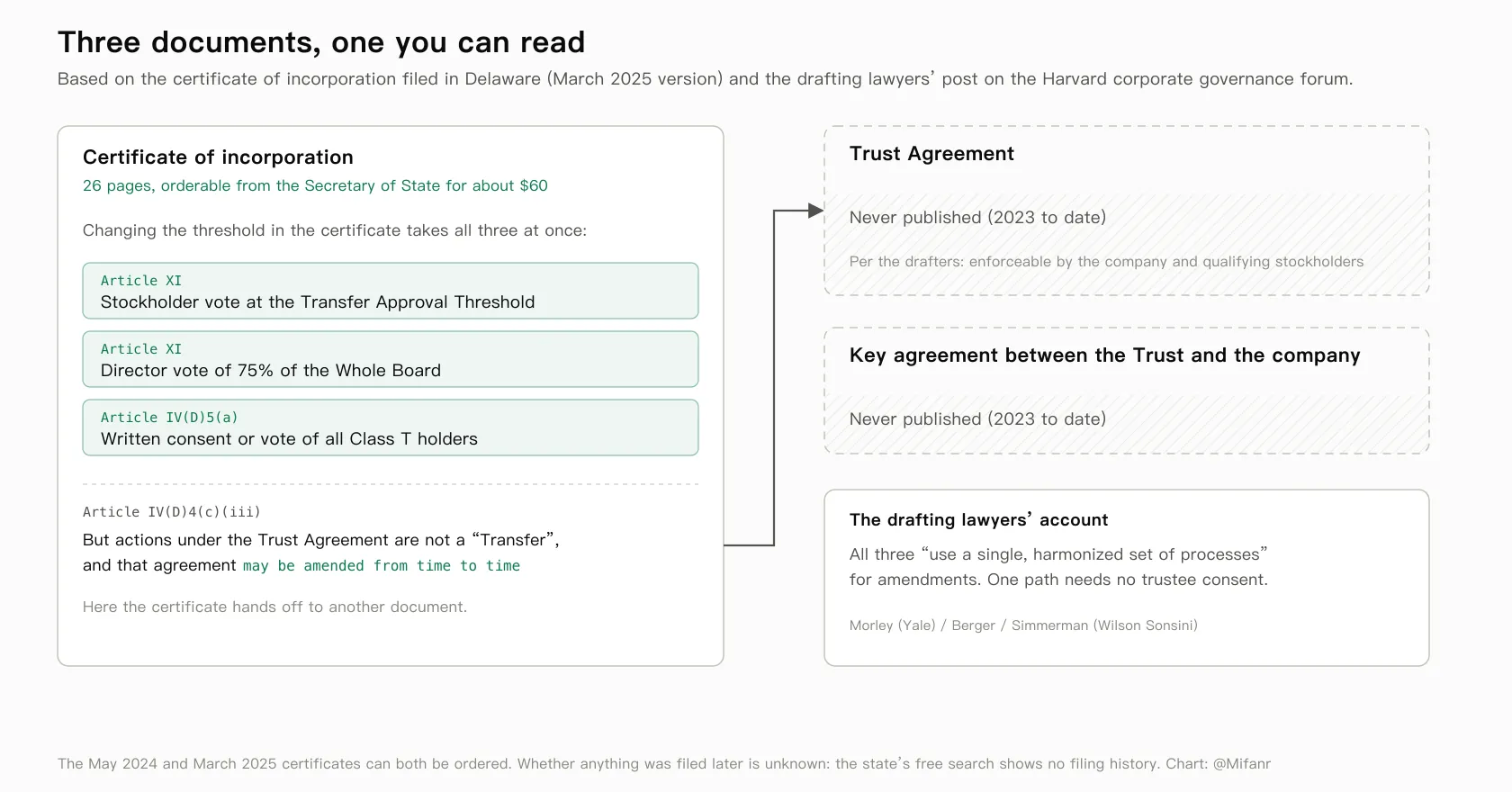
Two years ago Stein-Perlman wrote “Perhaps”. What turns “Perhaps” into “necessarily” is that the four corners of the certificate can’t hold a switch that works without the trustees’ consent, and that the certificate itself left a door open to the agreement.
Who can take this trust to court? The company
The key difference between a non-charitable purpose trust and a charitable trust is who can enforce it. A charitable trust has the state attorney general. A non-charitable purpose trust has no beneficiary, and so no natural plaintiff.
Delaware’s statute on non-charitable purpose trusts is 12 Del. C. § 3556, which the drafting lawyers cite in their own footnote as the basis. Its standard: except as otherwise provided by the governing instrument, a person that has an interest in the declared purpose of the trust other than a general public interest may petition the Court of Chancery to appoint or remove an enforcer.
And the stated purpose of the Long-Term Benefit Trust (LTBT) is, of all things, the long-term benefit of all humanity.
And who does the trust agreement give enforcement power to? Again, in the drafting lawyers’ own words:
As permitted by Delaware’s purpose trust statute, the Trust Agreement also authorizes the Trust to be enforced by the company and by groups of the company’s stockholders who have held a sufficient percentage of the company’s equity for a sufficient period of time.
“by the company”.
A trust meant to constrain the company has its enforcement power granted to that company itself, and to stockholders who have held a certain percentage for a certain period. Not the trustees. Not the public either.
In the same piece, the drafting lawyers set out three more things: the company chose the initial trustees; trustees serve terms of only one year; and trustee candidates are chosen after consulting the company’s directors and CEO.
Put these together, and the five seats being chronically unfilled stops looking like a coincidence. Renewal every year, selection by the sitting trustees, and candidates run past the party being constrained. I don’t find it strange that seats like these go unfilled.
Five trustees by design, three for most of three years
The first five trustees, announced on September 19, 2023: Jason Matheny (CEO of RAND), Kanika Bahl (CEO of Evidence Action), Neil Buddy Shah (CEO of the Clinton Health Access Initiative, chair), Paul Christiano (founder of the Alignment Research Center), and Zach Robinson (interim CEO of Effective Ventures US).
The announcement includes this sentence:
The Anthropic board chose these initial Trustees after a year-long search and interview process…
Anthropic later added footnotes to that page recording departures. Matheny left in December 2023, to avoid conflicts of interest with RAND’s policy work. Christiano left in April 2024 for the US AI Safety Institute. Bahl and Robinson left together in January 2026. Four of the five founding trustees are gone. Only the chair, Shah, remains.
The two who knew AI safety best were the first two to leave. The official reasons were a conflict of interest and another appointment, and I won’t attribute it to anything else here.
Counting from the dates of the official announcements, the headcount over three years went like this:
2023-09   5 trustees  (full strength, about 3 months)
2023-12   4 trustees
2024-04   3 trustees  ← held for about 13 months
2025-05   4 trustees  (Fontaine joins)
2026-01   3 trustees  (Cuéllar in, Bahl and Robinson out)
2026-07   4 trustees  (Bernanke joins)
2026-08   3 trustees  (Cuéllar out)
Of 36 months, only the first 3 or so had the full five, and about 20 had three.
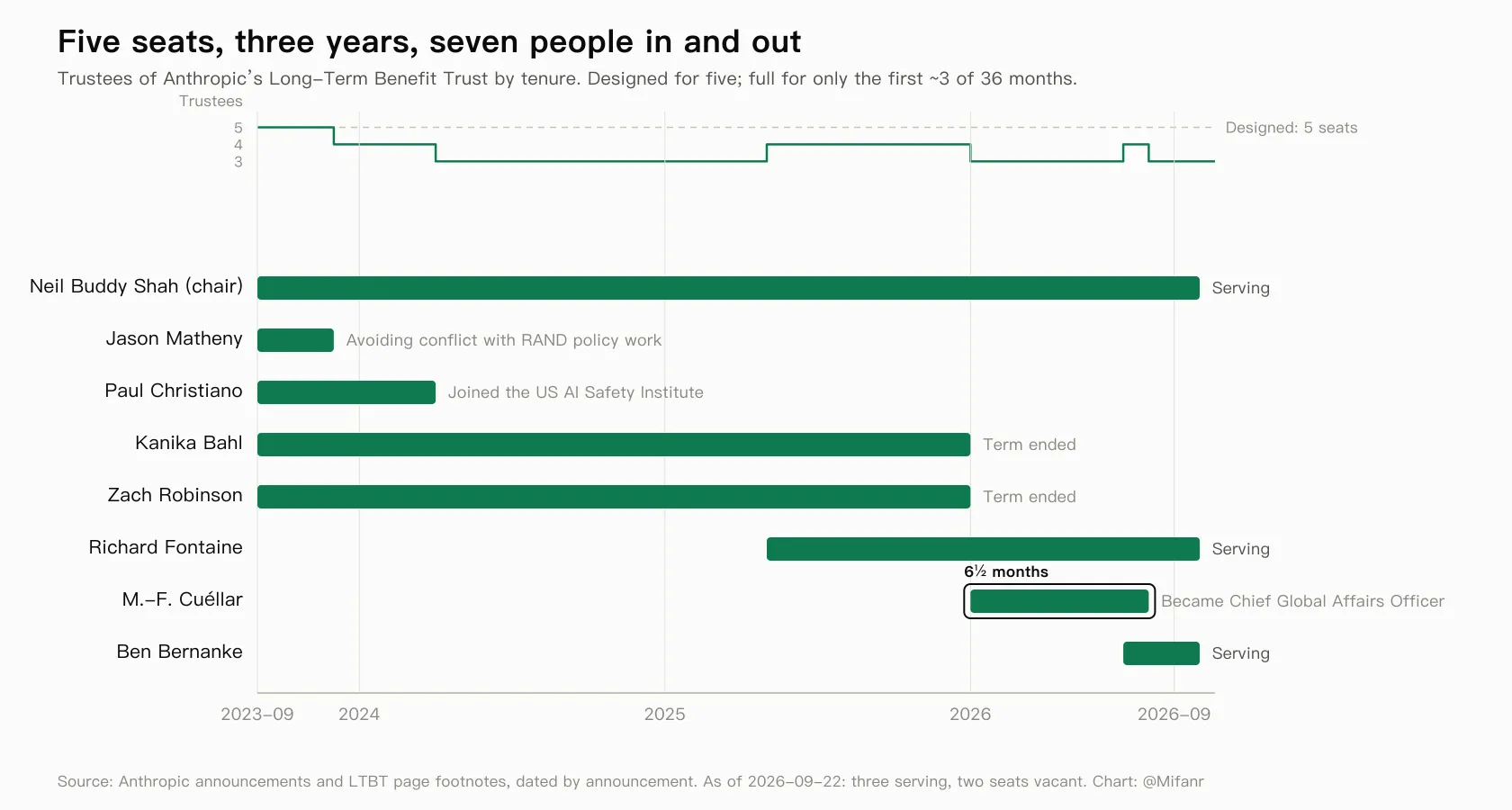
The body of that Anthropic page still says today, in the present tense, “an independent body comprising five Trustees”.
The official description of the succession process has also drifted over the three years. The September 2023 page says:
Trustees serve one-year terms and future Trustees will be elected by a vote of the Trustees.
The two appointment announcements of January and July 2026 put the same thing this way:
New Trustees are selected by the existing ones, in consultation with the company.
“elected by a vote of the Trustees” became “selected by the existing ones, in consultation with the company”. No announcement has explained the change.
This is drift in the public description. It doesn’t mean the underlying trust agreement was changed. The agreement is not public, and it may have said “in consultation with the company” from the start; the wording in the drafting lawyers’ article is closer to that. All that can be asserted is that the official public wording changed and nobody explained it.
The trust’s board majority lasted 38 days at most
On April 14, 2026, Vas Narasimhan joined the board. Anthropic’s announcement says:
With Narasimhan’s appointment, Trust-appointed directors now make up a majority of the Board. Narasimhan joins Dario Amodei, Daniela Amodei, Yasmin Razavi, Jay Kreps, Reed Hastings, and Chris Liddell on the Board of Directors.
A seven-member board, four of them from the trust. When Anthropic announced the trust in 2023, it said the trust would gradually come to elect a majority of the board; this was the first time it did.
On May 22, 2026, Jay Kreps announced on LinkedIn that he had left the board. Anthropic made no announcement. I could find no reason for his departure, and I won’t speculate.
The board Anthropic’s website lists today has six people: Dario Amodei, Daniela Amodei, Yasmin Razavi, Reed Hastings, Chris Liddell, Vas Narasimhan.
Three appointed by the trust (Daniela Amodei, Hastings, Narasimhan) against three elected by stockholders (Dario Amodei, Liddell, Razavi).
Three to three.
(On who holds which seat: Anthropic has said only for Kreps and Hastings that the trust appointed them. The rest comes from footnotes 291 and 294 of the Fried and Reiter paper. It fits the certificate’s seat structure: after November 2024 the board was fixed at five with three trust seats, and before Liddell joined in February 2026, the five were Kreps, Hastings, Razavi in the preferred seat, and the two Amodeis, so the trust’s third seat had to be one of the Amodeis.)
Article VIII(C) already says what happens when the board splits three to three:
If at any time the vote of the Board of Directors with respect to a matter is tied (a “Deadlocked Matter”) and the Chief Executive Officer of the Corporation is then serving as a director (the “CEO Director”), the CEO Director shall be entitled to an additional vote for the purpose of deciding the Deadlocked Matter (a “Deadlock Vote”) (and every reference in this Restated Certificate or in the Bylaws of the Corporation to a majority or other proportion of the directors shall refer to a majority or other proportion of the votes of the directors), except with respect to any vote as to which the CEO Director is not disinterested or has a conflict of interest, in which such case the CEO Director shall not have a Deadlock Vote.
The extra vote on a tie belongs to Dario Amodei, who sits on the stockholder side. The trust holds half the seats and less than half the votes.
Only the arrival of that majority was ever announced. Not its departure.
On September 4, 2026, the Financial Times ran a story by its AI editor, Madhumita Murgia, on Anthropic’s IPO and this trust, headlined “Anthropic’s $2tn IPO puts powerful external trustees in spotlight”. It says:
It has selected four of Anthropic’s seven directors, including Netflix’s co-founder Reed Hastings and Vas Narasimhan, chief executive of Novartis.
When it ran, Kreps had been gone for more than three months.
I don’t want to decide for readers that the FT got it wrong. It may be counting authorized seats, and the certificate gives that count some footing. Article IV(D)5(a)(iii) requires the trust’s consent to reduce the authorized number of directors, so Kreps’s seat is more likely vacant than abolished. It is a trust seat, and under Article VIII(B)5 a vacancy can be filled only by the trust or by the remaining directors the trust elected. If so, the trust still holds four of seven authorized seats; counting the people actually serving, the board is six, three to three, and the missing seat is one the trust itself has left empty for four months. The company hasn’t disclosed the authorized number, so this paragraph is an inference.
When that majority disappeared, no one had any obligation to say so.
Three years, as the FT tells it: advisory, no red lines
The same FT story also has a record of how the trust has operated, drawn from interviews. First, the access side:
The trustees are required to receive advance notice of major company actions, including the launch of new AI models. They meet weekly among themselves, while also meeting Anthropic’s leadership as frequently as every other week.
Weekly meetings among themselves, meetings with management as often as every two weeks, required advance notice of major actions including new model launches, and a seat in the room at board meetings.
The advance notice is written into the certificate. Article IV(D)5(b) provides that after the Second Phase-In Date (May 24, 2026 at the latest), a liquidation, a transfer of control of an AI model above the capability thresholds, a sale of half or more of the stock, and certain other actions such as issuing debt or granting liens require at least five calendar days’ written notice to the Class T holders. The same provision goes on:
provided, however, any holder of shares of Class T Common Stock shall be deemed to have waived such notice if such holder does not object to such act or transaction in writing within five (5) calendar days of the time that such holder becomes aware of such act or transaction
The FT continues:
Yet despite that access and authority, the trust has operated largely in an advisory capacity. It has not attempted to draw red lines or force a significant trade-off between profit and purpose
Three years, mostly advisory, never a red line drawn, never the company forced into a significant trade-off between profit and purpose.
The FT found two cases as its strongest examples of intervention: the Mythos cybersecurity model going out in a limited release through Project Glasswing, which the FT says the trustees “encouraged”, and the company’s dispute with the US government over autonomous weapons.
The limited release itself has independent sources: Anthropic’s own announcement, “Expanding Project Glasswing”; reports in The Sydney Morning Herald and Malaysia’s The Star on June 3 that access was growing to about 200 Glasswing partners; and a Forbes piece on April 8 about why it stayed invitation-only. The word “trustee” appears nowhere in the Sydney Morning Herald story. For the trustees’ role, the FT is the only source, and an anonymous one. Glasswing itself is a program Anthropic promoted loudly.
In that story about governance transparency, there isn’t a single on-the-record response from Anthropic. The key information hangs on sources like “a person close to Anthropic” and “a person familiar with”. The FT doesn’t write “declined to comment”, so I can’t say Anthropic declined to respond, only that no named statement from the company appears in the piece.
The strongest rebuttals, and the one I have to concede
These are the strongest rebuttals I could find, and one of them I have to concede.
Compared with what.
Google’s 2018 AI principles said it would not build weapons, or surveillance that violates international norms. In February 2025 those commitments were deleted wholesale. The cost was editing a web page: no board resolution, no stockholder vote, no third-party consent. The friction coefficient was zero.
What does it take to touch the LTBT? A board resolution, the Transfer Approval Threshold, 75% of the Whole Board, and, per the text of the certificate, the consent of the Trust, as holder of all the Class T shares, as well. I can say this isn’t a real constraint, but I have to admit its friction coefficient isn’t zero. In this industry, anything above zero is already rare.
The Harvard Law School paper reaches the opposite conclusion from mine.
Jesse Fried and Idan Reiter’s May 2026 paper, “AI Corporate Governance and Ben & Jerry’s Risk”, studies this very failsafe. Their conclusion:
The most important difference between Anthropic PBC and OpenAI Group PBC is that an unspecified super-majority of Anthropic PBC investors can unilaterally amend the Trust…
And they consider this a strength. Because of the switch, they argue, Anthropic’s structure is less likely to blow up than OpenAI’s or Ben & Jerry’s, and they even predict that those who come later should copy it.
Fried’s explanation of the mechanism: the switch constrains the guardians themselves, not the mission. The guardians know they can be thrown out, so they back down when investors strongly object.
It puts a constraint on the guardians, because they don’t want to be thrown out. … If investors really don’t like what the guardians are planning to do, I expect the guardians will back off.
This is the objection most worth taking seriously, because Fried and I agree completely on the facts. He says the guardians will back down. I say power flows back to the party being constrained. We are describing the same fact.
The disagreement is about the standard. Fried starts from investor protection and asks whether the guardians will overreach. I start from whether the constraint works and ask whether the guardians can make it hold even once. Looking at the same switch, he sees design and I see a gap.
I’m not going to pretend I can win this disagreement. I only want to lay it out. The structure meets Fried’s standard and fails mine at the same time, because it was built all along to be controlled, not to control.
The two share one word.
(In passing, one weak point in their paper: they read Article IV(D)5(a) as protecting only “board-appointment rights”, but the text of 5(a)(i)(1) covers the whole of Article IV(D), and (i)(2) also catches any amendment to the certificate or bylaws that is adverse to Class T, a much wider scope. And their claim about the kill switch footnotes the drafting lawyers’ article, not the text of the certificate.)
Board seats are real power.
The trust has appointed four directors over time, including someone of Reed Hastings’s stature. Under Delaware corporate law, directors have independent fiduciary duties and don’t take instructions from whoever appointed them. Say that a body able to put three or four people on the board has no influence at all, and even I wouldn’t believe it.
There is one more point I have to concede.
In November 2023, OpenAI’s nonprofit board had the unconditional power to fire the CEO, unchecked by any stockholder. By the test this piece uses, whether power flows back to the party being constrained, it scored full marks.
It used that power. Five days later it was routed: about 700 employees (more than 90% of staff) signed a letter demanding that the board resign, Microsoft applied pressure, Altman came back, and the original board was replaced.
So control that is formally complete and doesn’t flow back doesn’t amount to an effective constraint either.
My test was too strict, then. By that standard, no governance structure could pass.
In 1952, a London court struck down a trust like this
In February 1945, Waldorf Astor, 2nd Viscount Astor, his second son David, and three trustees made an inter vivos settlement and put shares of The Observer into it. Its stated purposes were maintaining good understanding between nations, and preserving the independence and integrity of newspapers.
In 1952, in Re Astor’s Settlement Trusts, the Chancery Division of the English High Court held it void. Mr Justice Roxburgh wrote in the judgment:
it is not possible to contemplate with equanimity the creation of large funds devoted to non-charitable purposes which no court and no department of state can control, or in the case of maladministration reform.
A rich man wanted to use a trust to lock in abstract public goods like international understanding and press independence, and the court said it could not stand. The reason wasn’t that his motives were suspect. It was that no one could control it.
This isn’t an isolated case. The common law uses three locks to stop anyone from controlling property forever into the future, and Re Astor sits on the first of them.
The first is the beneficiary principle. In the 1804 judgment that established it, Sir William Grant, Master of the Rolls, put it most bluntly:
There must be somebody, in whose favour the Court can decree performance.
In the same passage he also said that an uncontrolled power of disposition would be ownership, not trust.
The second is the rule against perpetuities. John Chipman Gray, the American scholar who wrote the classic treatise on the rule, characterized it this way:
The Rule against Perpetuities is not a rule of construction, but a peremptory command of law. … Its object is to defeat intention.
It isn’t a rule of construction that helps you work out what the settlor wanted. It exists to beat him. The rule’s own measure: no interest is good unless it must vest, if at all, not later than twenty-one years after some life in being at the creation of the interest. One human life, plus twenty-one years. Roughly the people you know, plus their children growing up.
The third follows from the first two: the common law limit on how long a non-charitable purpose trust can last.
In 1942 the US Supreme Court put the whole apparatus in its place:
the dead hand rules succession only by sufferance.
Sufferance means it is a grace, not a right, and the legislature can take it back at any time.
Seventy years after Re Astor, a company set up a non-charitable purpose trust in Delaware for the long-term benefit of all humanity.
What happened in between wasn’t progress in legal doctrine. Delaware undid those three locks one at a time.
How Delaware made it legal and kept the public out of court
Delaware did not, and could not, “overturn” Re Astor. It was an English High Court judgment and was never binding in Delaware. What the legislature did was replace, by statute, the entire common law rule the judgment rested on.
12 Del. C. § 3556(1)–(2) says that a trust for a declared purpose that is not impossible of attainment is valid, and is not invalid because it lacks an identifiable person as beneficiary.
Roxburgh’s line of reasoning, void because no one can enforce it, is no longer an available ground for invalidity under Delaware law.
Delaware didn’t touch a word of his other ground. Re Astor had two grounds for voiding the trust: besides the beneficiary principle, the purposes were stated too uncertainly. The only threshold § 3556 keeps is that the purpose not be impossible to achieve, and that is about impossibility, not uncertainty. That road is still open in Delaware. No published case has gone down it.
As for perpetuities, 25 Del. C. § 503(a) deals with real and personal property together: an interest in real property held in trust is not void under the common law rule against perpetuities or any common law rule limiting the duration of non-charitable purpose trusts, and an interest in personal property held in trust is not void under any rule.
§ 503(b) keeps a 110-year limit, for real property only. And § 503(e) expressly excludes interests in entities such as corporations, limited liability companies, and partnerships from real property, whether or not the entity itself holds real property.
A Delaware purpose trust that holds only stock isn’t subject even to the 110-year limit.
The cost is in who can enforce it.
§ 3556(3) provides that a person that has an interest in the declared purpose of the trust other than a general public interest may petition the Court of Chancery to appoint an enforcer, or to remove anyone previously nominated or currently serving as enforcer.
The statute doesn’t say “only”, and it doesn’t expressly bar anyone else from petitioning. The public is kept out by the combined effect of this affirmative grant and the structure of having no identifiable beneficiary.
The door was this narrow when the law was enacted in 2008. I pulled the original text from that year and checked it: that sentence has not changed by a word.
2025 brought three other changes.
First, a switch was added in front of that sentence: “Except as otherwise provided by the terms of the governing instrument”. Now even this narrow door can be shut by the governing instrument.
Second, a new sentence lets the governing instrument give the enforcer, or some other person, exclusive standing to enforce the terms of the trust.
Third, a whole sentence was added at the end of § 3556(2): except as otherwise provided by the governing instrument, a person is not treated as a beneficiary of the trust merely because the person has received, or is receiving, disbursements from the trust in furtherance of its declared purpose.
The third sentence is the cleanest link in the chain. Taking this trust’s money doesn’t give you beneficiary status, or the standing to sue that comes with it. The back door is welded shut too.
And these three additions went into the code in 2025.
The other route the law leaves open for binding something permanently is the charitable trust. That route comes with supervision by the state attorney general, which means accepting a public plaintiff with parens patriae standing.
The one time in history a structure like this was stopped, it was this role that stopped it. In 2002 the Milton Hershey School Trust set out to sell its controlling stake in Hershey. The Pennsylvania attorney general, using parens patriae power, petitioned the Orphans’ Court for a special injunction, which was granted on September 4. On September 18, Pennsylvania’s Commonwealth Court upheld it, with Judge Pellegrini dissenting on the ground that the attorney general had no authority to become fully involved under a parens patriae theory. A footnote in the judgment defines the term:
“Parens patriae powers” refers to the “ancient powers of guardianship over persons under disability and of protectorship of the public interest which were originally held by the Crown of England as ‘father of the country,’ and which as part of the common law devolved upon the states and federal government.”
On the OpenAI side, the Delaware Department of Justice described its own role like this in a press release last year:
Under Delaware law, the Attorney General serves as the representative of beneficiaries of nonprofit entities (i.e., “all of humanity” in the case of OpenAI).
In a non-charitable purpose trust, nobody sits in the position that sentence describes.
Anthropic chose a non-charitable purpose trust. Its advantage and its drawback are the same thing: no public oversight. It wanted permanence, and it took a road that doesn’t accept public oversight. The other road the law opens to permanence has a price, and the price is accepting public oversight.
What worked was never in the provisions
Back to those five days at OpenAI. They overturned my original test.
Ben & Jerry’s shows something else. When Unilever bought it in 2000, it agreed to keep an independent board to guard the brand’s social mission, the closest precedent to the LTBT. Unilever, and later its spin-off Magnum, got around that board twice, and neither time by vote. In 2021 the independent board decided to stop sales in the Israeli-occupied territories; in 2022 Unilever went over its head and sold the Israeli business to the local licensee, so the ice cream stayed on sale. In December 2025 Magnum changed the bylaws to impose a nine-year term limit, and several long-serving independent directors lost their seats. People who set out to break a lock don’t go the supermajority route. They change the rules, or go around them.
Altman came back in five days because of employees, customers, and Microsoft. The Hershey sale was stopped by a state attorney general with standing to sue.
None of these are provisions.
So now I’m not sure this piece is asking the right question. “Can this structure constrain the party it is supposed to constrain?” assumes that constraint comes from provisions.
To touch the LTBT you have to convene the board, round up the votes, and do it in public, and doing it in public has a reputational cost. Fried calls this good, controllable design. I had meant to call it friction rather than constraint. We are talking about the same thing, and I still haven’t worked out which description is more accurate.
Anthropic’s website calls it an experiment, and says it isn’t yet ready to hold it up as a model worth copying. I think that characterization is honest.
What stopped me is a word. Trust.
It let the FT count as current a director who had left four months earlier, let a Harvard paper cite the drafting lawyers’ account instead of reading the text, and let nearly every secondhand quotation carry a hyphen that isn’t in the filing.
Once the registration statement is public, if the trust agreement counts as a material contract outside the ordinary course of business, Anthropic will have to file it as an exhibit. Anthropic confidentially submitted a draft registration statement to the SEC on June 1. The Wall Street Journal reported on September 18 that the listing target had slipped from October to November, and under SEC rules the public version has to be filed at least 15 days before the roadshow.
I’ll read it.
How this piece was made
Document versions. This piece cites two versions of the certificate of incorporation. One is the filing with the Delaware Secretary of State dated May 20, 2024 (SR 20242293471, File Number 4860621, 26 pages), which Zach Stein-Perlman obtained from the state and published in 2024. The other is the March 7, 2025 version (SR 20250960832), ordered by Drake Thomas and uploaded in November 2025. Unless noted, all quotations of provisions come from the March 2025 version. The same batch of uploads includes a July 3, 2025 filing (SR 20253269483), the latest version I could find; the eight provisions quoted here are word for word the same as in the March version, and authorized shares rise to 1,790,472,959, with Class T still at 1,000. All three are scans with no text layer. I rendered them at 300dpi and ran OCR, and checked pages 17 to 20 and pages 24 and 25 word for word against the page images.
What I couldn’t do. I did not contact Anthropic for comment. A proper publication gives the subject a chance to respond before running a piece like this, and prints the response or “did not respond to a request for comment”. That “did not respond” is information in itself. I can’t do that step.
What I couldn’t verify, item by item.
- The exact date Jay Kreps left. He announced it on LinkedIn, and Anthropic made no announcement. The post went up at 10:03 a.m. Pacific on May 22, 2026; the page shows only a relative time, and I decoded the timestamp from the post ID. The post says “I’ve stepped down”, so he may have left before that day. I found nothing at all on why he left, and this piece doesn’t speculate.
- Who holds which board seat. Anthropic has stated only for Kreps and Hastings that the trust appointed them. Daniela Amodei in a trust seat and Liddell in a common seat come from footnotes 291 and 294 of the Fried and Reiter paper; Anthropic has not confirmed them publicly.
- The full text of the trust agreement has never been published. Everything in this piece about it comes from three indirect sources: the prose description on Anthropic’s website, the drafting lawyers’ article on the Harvard Law School Forum on Corporate Governance, and the reference to it in Article IV(D)4(c)(iii) of the certificate. The agreement’s amendment thresholds, the trustees’ quorum, and the specific ownership and holding-period requirements for enforcers are all unknown.
- I can’t confirm whether anything new has been filed since July 2025. The state’s online search doesn’t list filings. The only way to find out is to pay for a complete set of the current documents including all amendments.
- Page numbers for Re Astor. I couldn’t get the official ICLR report (the Law Reports, Chancery Division, sit in a paid database, and BAILII doesn’t carry the case). The best secondary source I could reach is a peer-reviewed journal that reproduces the passage word for word and gives the page as 542. So the piece gives no page range. The line about a court of equity not recognizing a trust it cannot both enforce and control appears with page numbers only on Wikipedia and a few study sites, with no primary source I could check, so the body doesn’t quote it. The Wikipedia page gives pages 541–2 and 549, but it describes the case as a challenge to Waldorf Astor’s will after his death, which doesn’t match the standard account of the judgment, so its page numbers are only a lead.
- Delaware statutes. I checked the text of 12 Del. C. §§ 3556 and 3303, 25 Del. C. § 503, and 8 Del. C. §§ 365 and 367 one by one against the official text of the Delaware Code, and for the 2025 amendments I also checked the session law (85 Del. Laws c. 160) and the original 2008 text (76 Del. Laws c. 254). The codified numbering differs from the session law’s: the Code numbers the paragraphs (1)–(8), and the session law as enacted numbers them (a)–(h), with the same content. The body uses the Code’s numbering.
- The Hershey timeline. The source is In re Milton Hershey School Trust, 807 A.2d 324 (Pa. Commw. Ct. 2002), which appends the Orphans’ Court’s order. September 3 was the hearing, with no ruling that day; the injunction order is dated September 4; the appeal was argued September 11 and decided September 18. Also, the current text of 20 Pa.C.S. § 7203(d) is the version as amended in 2004, not the 2002 one, so the body doesn’t quote the statute.
- The two attorney general offices in the OpenAI matter. California and Delaware acted on different grounds, and their documents are not the same thing. The sentence quoted in the body comes from a Delaware Department of Justice press release. The text of Delaware’s Statement of No Objection itself has not been published. The often-cited requirement of 21 days’ advance notice of a change of control is a term in California’s memorandum of understanding, not Delaware’s, and the body doesn’t mention it.
- The Financial Times piece of September 4, 2026 is paywalled. I read an archive.today snapshot.
- The founders’ super-voting shares. The source is The Information’s report of August 18, 2026, by Cory Weinberg and Valida Pau (paywalled; I read Reuters’ summary), which Reuters and Bloomberg picked up the same day. That is not three independent confirmations. The exact vote ratio has never been disclosed.
One concession. The core reading here, about the 1,000 shares and the trust agreement, wasn’t mine first. Zach Stein-Perlman sketched its skeleton in a footnote in June 2024, and the body quotes it in full.